
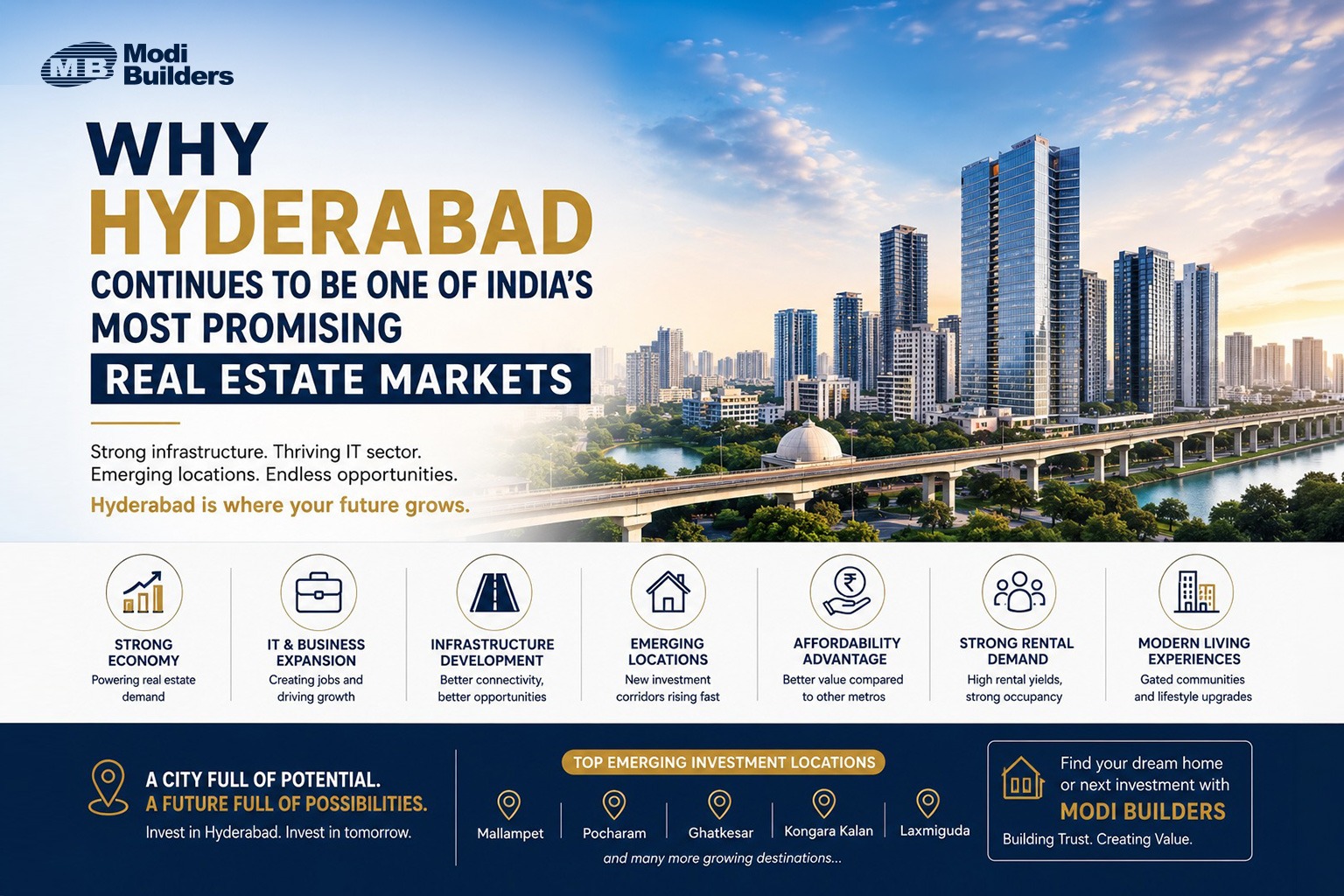

Hyderabad is one of those cities that kind of sneaks up on you. A decade ago, most people outside Telangana associated it with biryani, the Charminar, and the IT boom that was still finding its footing. Today it’s quietly become one of the more interesting real estate conversations happening in India and I don’t mean that in the breathless, every-city-is-booming way that gets thrown around in investment circles. I mean there are actual structural reasons why the market here has held up while others have wobbled.
And honestly, that’s worth paying attention to.
The Growth Here Isn’t Built on Hype
Here’s what I keep coming back to when I think about Hyderabad’s real estate story: the demand is real. People aren’t buying property here because some analyst told them prices would double. They’re moving here because the jobs are here. The companies are here. The opportunities are here.
That’s a different kind of foundation entirely.
Most cities that experience real estate booms eventually hit a wall when the speculative layer peels away and there’s nothing underneath. Hyderabad’s growth has been stickier because it’s backed by genuine migration — professionals from across the country relocating for work, families following them, businesses expanding their footprint. When people need to live somewhere, housing demand doesn’t evaporate when sentiment shifts.
That’s not a small distinction. That’s the whole ballgame, really.
 Employment Hubs Are Doing Exactly What They’re Supposed to Do
HITEC City, Gachibowli, the Financial District — these aren’t just branding exercises anymore. They’ve become legitimate anchors of economic activity, and the residential demand radiating outward from them has been pretty consistent.
What I find interesting is how the pattern plays out. A professional relocates from Chennai or Pune for a role in one of the tech parks. They rent initially, get a feel for the commute, figure out which neighborhoods don’t make them want to throw their laptop, and eventually buy. That cycle repeats thousands of times a year. And it keeps residential demand across multiple price points fairly healthy.
For investors, this matters because demand that’s employment-driven tends to stay more stable than demand that’s trend-driven. People don’t stop needing housing just because the news cycle moves on.
Infrastructure Is Actually Catching Up Which Changes the Calculus on a Lot of Locations
The Outer Ring Road changed things more than people give it credit for. Areas that used to feel unreachably distant from the city suddenly had reasonable commute times. The airport corridor got more accessible. And as a result, the investment map for Hyderabad expanded significantly.
I remember when Gachibowli was considered a stretch for most buyers. That feels almost laughable now. The same kind of repositioning is happening — more slowly, sure — with areas like Ghatkesar, Mallampet, and Kongara Kalan. Not because someone decided to hype them up, but because roads got built and travel times dropped.
Infrastructure is boring to talk about. It’s also genuinely the thing that makes or breaks long-term real estate value, and Hyderabad has been spending on it in ways that keep showing up in property appreciation patterns.
The Affordability Argument Is Still Holding For Now
Prices have gone up. I’m not going to pretend otherwise. But the comparison to Mumbai and Delhi still makes Hyderabad look like reasonable value, especially when you factor in what you actually get for the money.
A 2BHK in a gated community with a clubhouse and decent green space? In Hyderabad, that’s still accessible to a working professional with a solid income and some savings. In Mumbai, the same budget buys you something much smaller in a location that may or may not work for your commute. That gap hasn’t closed as fast as some people expected.
Young buyers especially seem to notice this. It’s often their first major financial decision and they’re doing the math carefully. Hyderabad keeps coming out ahead on the value-per-rupee calculation, which is why first-time homebuyers haven’t exited the market here the way they have in some other metros. The Emerging Corridors Worth Watching
This is where it gets genuinely interesting and also where I’d urge a bit of patience, because “emerging” is doing a lot of work in a lot of those location pitches.
That said, a few areas have real substance behind the interest:
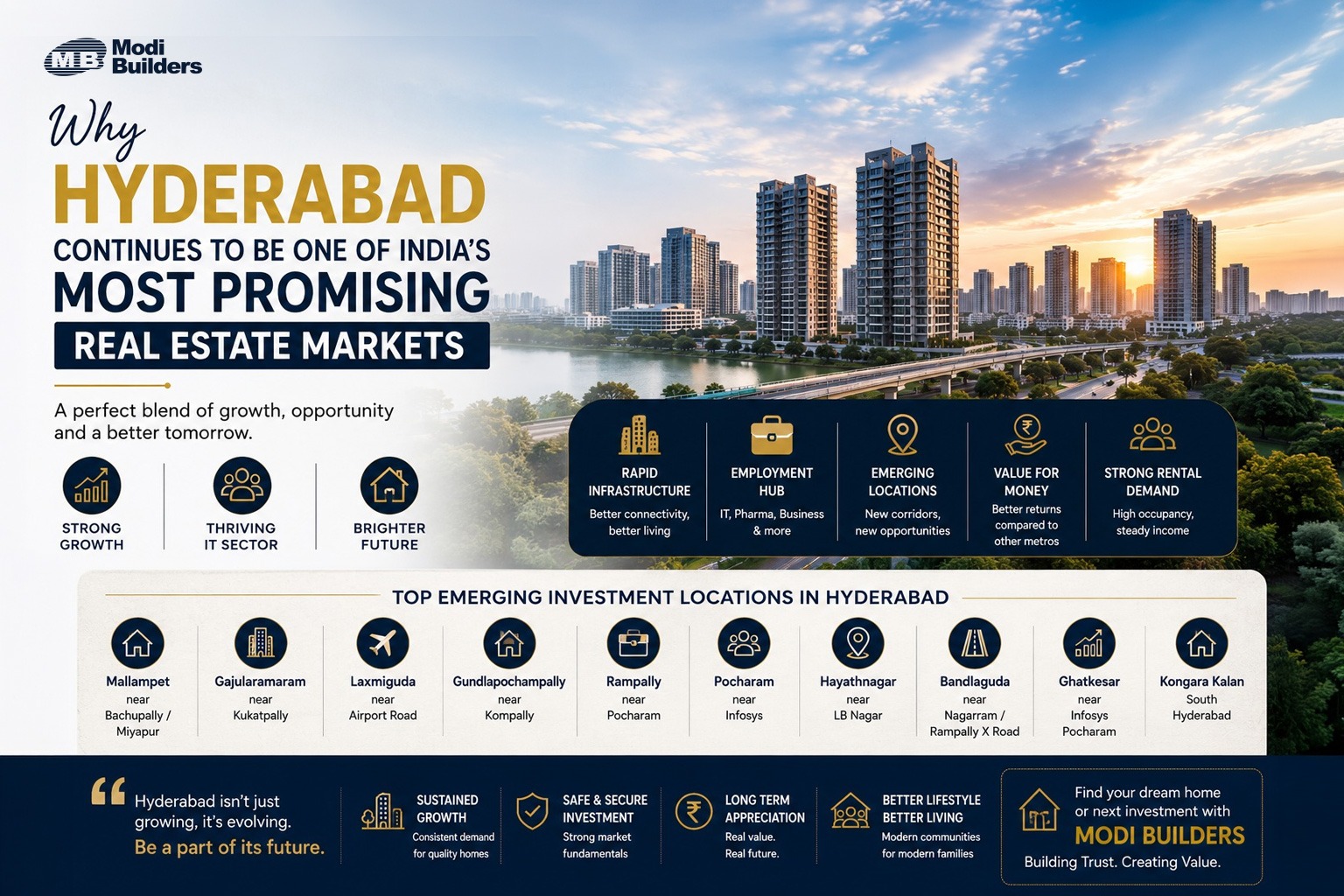
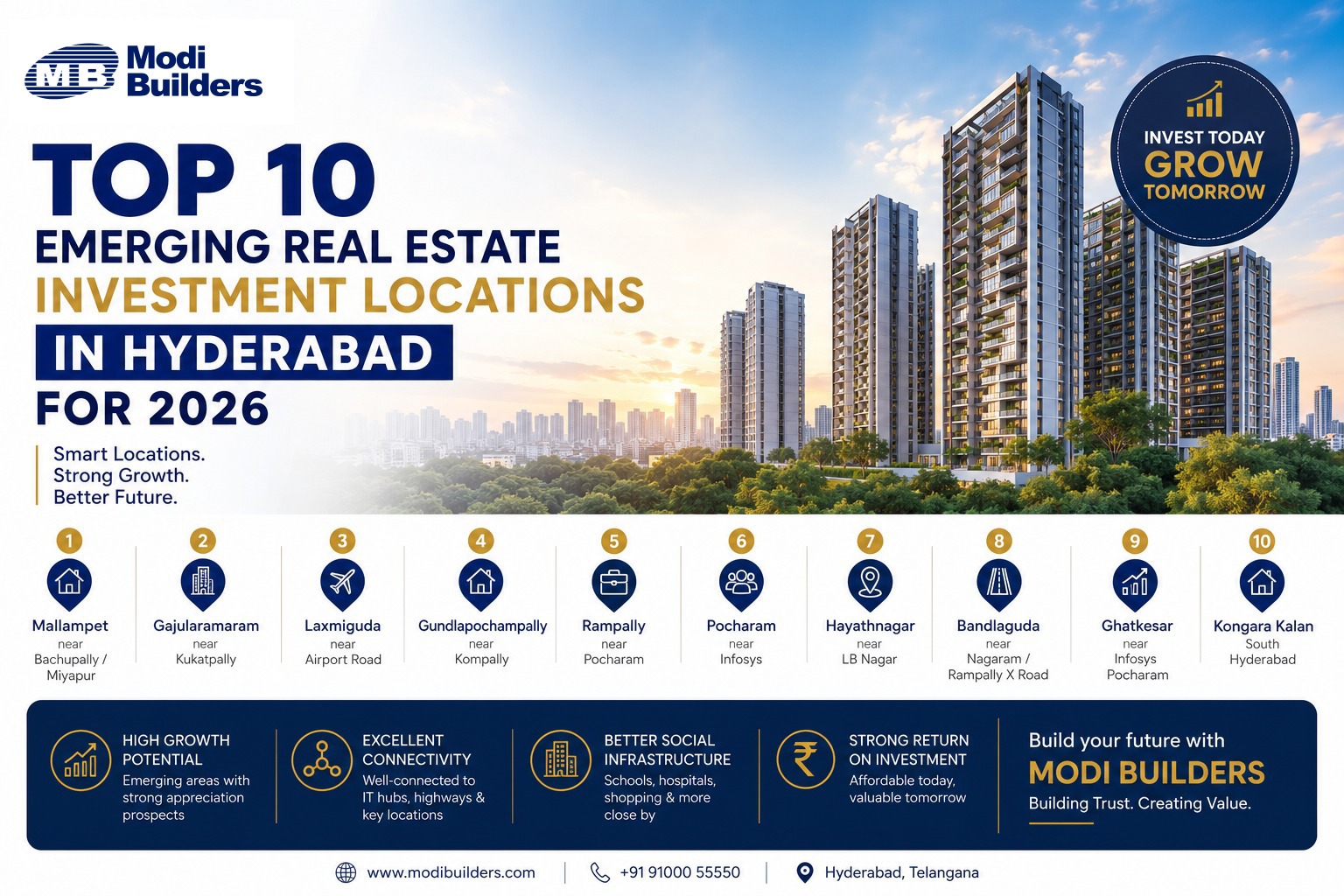
Mallampet sits close to Bachupally and Miyapur, both of which have matured considerably. Connectivity is improving and residential development is following. Not a surprise pick, but a logical one.
Gajularamaram, near Kukatpally, is the kind of place that families find when they’re priced out of their first-choice neighborhoods and then realize it’s actually quite liveable. That’s not a knock that’s how a lot of solid residential markets form.
Laxmiguda and Kongara Kalan are getting attention primarily because of the airport corridor story, which I think is legitimate. Cities with strong airport connectivity tend to see sustained commercial and residential development in those surrounding zones. Whether Hyderabad fully follows that pattern is something to watch rather than assume, but the early signals are reasonable.
Pocharam and Rampally are being carried by proximity to employment centers in the east. Ghatkesar is slowly accumulating development activity. These aren’t overnight stories but for investors with a five-plus year horizon, they’re worth understanding.
Rental Demand Isn’t Going Anywhere
The rental market in Hyderabad is one of those background facts that doesn’t get enough attention. Thousands of professionals relocate here every year, and most of them rent before they buy. Students, short-term project workers, families in transition they all contribute to a rental pool that’s been consistently healthy near the employment corridors.
For investors, rental yield isn’t the only metric that matters, but it’s the one that tells you whether the market has actual users or just speculative buyers. Hyderabad’s rental demand suggests real users. That’s a meaningful signal.
A Few Things Worth Keeping Honest About
No real estate market is a sure thing. I’d be doing a disservice to anyone reading this if I wrapped it up with some triumphant forecast.
Property appreciation is never guaranteed. Emerging locations can stay “emerging” for a long time before they deliver. Infrastructure timelines in India are famously optimistic. And any investment decision made without proper due diligence site visits, legal checks, builder track record, local supply-demand dynamics is just gambling with extra steps.
What Hyderabad offers is a more solid foundation for long-term consideration than many markets of comparable size. That’s meaningful. It’s not a guarantee, but it’s meaningfully different from buying into a market propped up entirely by sentiment.
Where Things Stand in 2026
The city’s fundamentals are largely intact. Employment is being generated. Infrastructure is expanding, if imperfectly. Affordability relative to other metros is still a real differentiator. And enough new residential corridors are developing to give investors at different budget levels something to actually evaluate.
Whether that translates into the right investment for any specific person depends entirely on their timeline, their risk tolerance, and how carefully they do their homework before signing anything.
But as markets go and I keep coming back to this Hyderabad is one where the underlying story makes sense. That’s rarer than it sounds.
FAQ Section
1. Why is Hyderabad considered one of the best cities for real estate investment?
Hyderabad offers strong infrastructure, growing employment opportunities, affordable property options, and consistent residential demand, making it attractive for investors.
2. Is Hyderabad a good place to invest in property in 2026?
Yes. Hyderabad continues to show strong growth due to expanding business hubs, infrastructure development, and increasing demand for residential properties.
3. Which are the fastest-growing residential areas in Hyderabad?
Mallampet, Pocharam, Ghatkesar, Kongara Kalan, Laxmiguda, Hayathnagar, and Gundlapochampally are among the emerging residential locations gaining investor attention.
4. What is driving Hyderabad’s real estate growth?
The key factors include IT sector expansion, infrastructure projects, airport connectivity, metro development, and increasing migration for employment opportunities.
5. Is Hyderabad’s rental market strong?
Yes. Hyderabad has a healthy rental market due to demand from IT professionals, students, business employees, and families relocating to the city.
6. Are emerging locations in Hyderabad worth investing in?
Emerging locations often offer better affordability and long-term appreciation potential compared to already established markets.
7. How does Hyderabad compare to other metro cities for property investment?
Compared to many major metro cities, Hyderabad offers better value for money, lower property costs, strong infrastructure, and significant future growth opportunities.
8. What should investors consider before buying property in Hyderabad?
Investors should evaluate location, connectivity, builder reputation, legal approvals, future infrastructure developments, and long-term appreciation potential.








Sorry, the comment form is closed at this time.